

What happens in a paint color consultation
You've probably neverhired a color consultant.Here's exactly how it goes.
A paint color consultant helps you choose paint colors your home can actually wear — tested against your real light, floors, brick, and furnishings instead of a store display. In Atlanta, that's me: Patricia Smith of The Colour Chameleon. I come to the house, work through each space with you, and leave you a specific scheme of colors and swatches to hand your painter.
You get in touch
Tell me the house, which rooms or which sides of it are getting painted, and — the one that matters most — when your painters need an answer. Timing matters more than people expect. A color chosen at eleven at night against a deadline is the kind that gets repainted, and I would rather find you a slot than be the last step in a rush.
Then we set a time. That's the whole of the first step: a message, a few details, a date.
Worth having handy
- The rooms, or the sides of the house, that are actually getting painted
- When the painters start — or when you'd like them to
- What isn't changing: the floors, the countertops, the roof, the brick
You talk. I listen.
We start with how you live in the house. Your lifestyle, your tastes, what you already love in it, what you've been staring at for two years and can't stand, the colors that are staying whether we like them or not. And the question that moves more schemes than any other: is this your forever home, or the one you sell in three years? Those two answers do not lead to the same palette.
This is the part people tell me they didn't get last time. If someone has already forced your hand once, you know exactly what I mean. My taste is not the thing we're here to install.

The decks come out after the conversation, not before. I read the house the way the paint will
Then I walk it. The light, and how it moves through a room between morning and evening. The flooring, and the undertone it pushes up onto every wall above it. The furnishings and the art you have no intention of replacing. The trim, the ceilings, and the doorways where one color has to hand off to the next.
Outside it's the brick, the mortar, the stone and the roof — a color scheme you already own and are not changing — plus full sun, which brightens a color well past what the chip promised indoors, and the two houses standing either side of yours.
This is the part that explains why the chip lied to you. It didn't, exactly. It just never met your house.
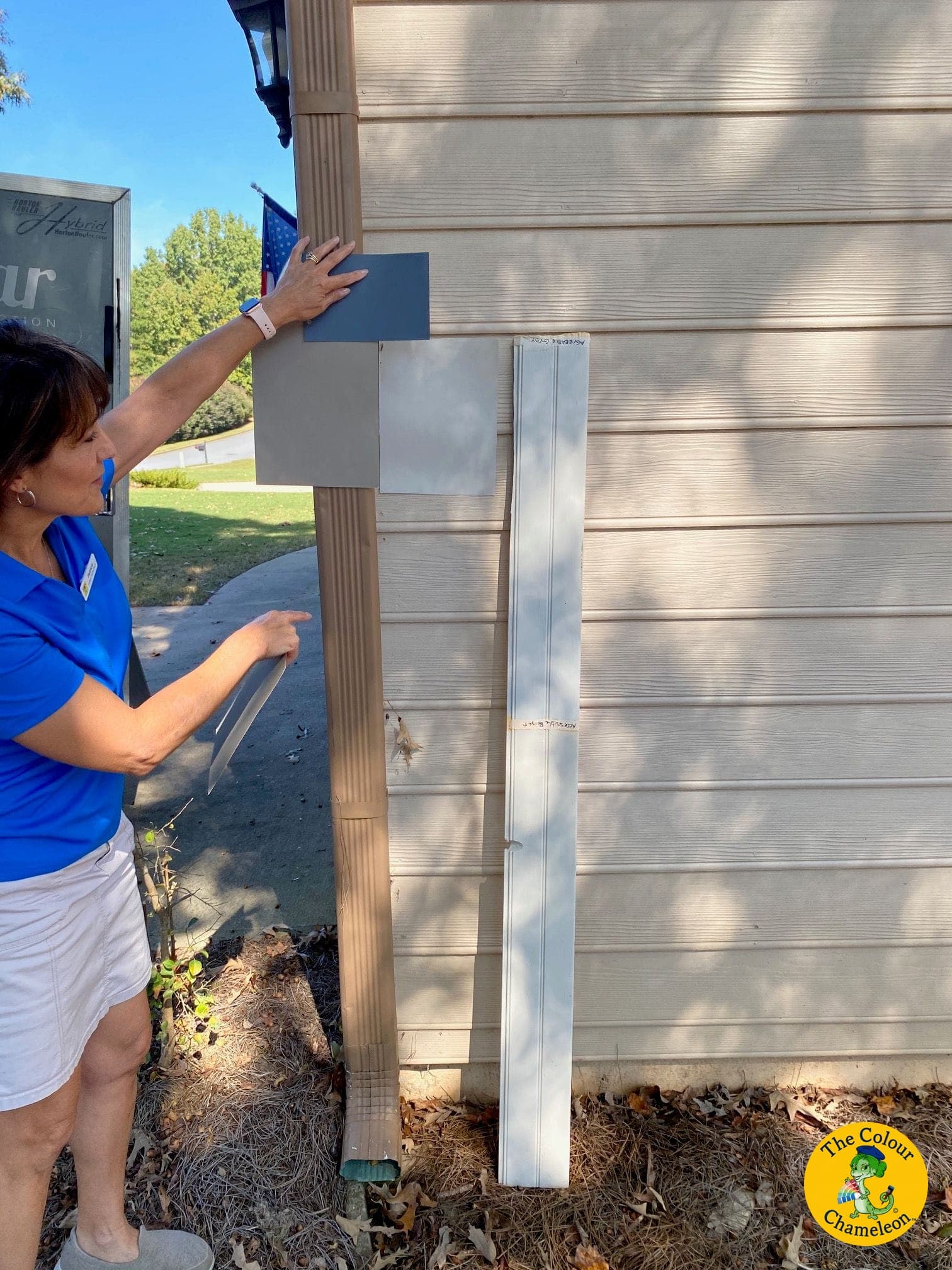
Held against the real siding, in the sun it will actually live in. We build the scheme together, out loud
From what I saw and what you told me, I develop a paint color scheme for this house — walls, trim, ceilings, doors, and how one room hands off to the next. Then we review the palette together, standing in front of the actual walls, and we adjust it.
That last part is the one that surprises people. It isn't a verdict handed to you at the door. We change whatever you don't love until the scheme is one you would have chosen yourself, if you could have seen it from here.
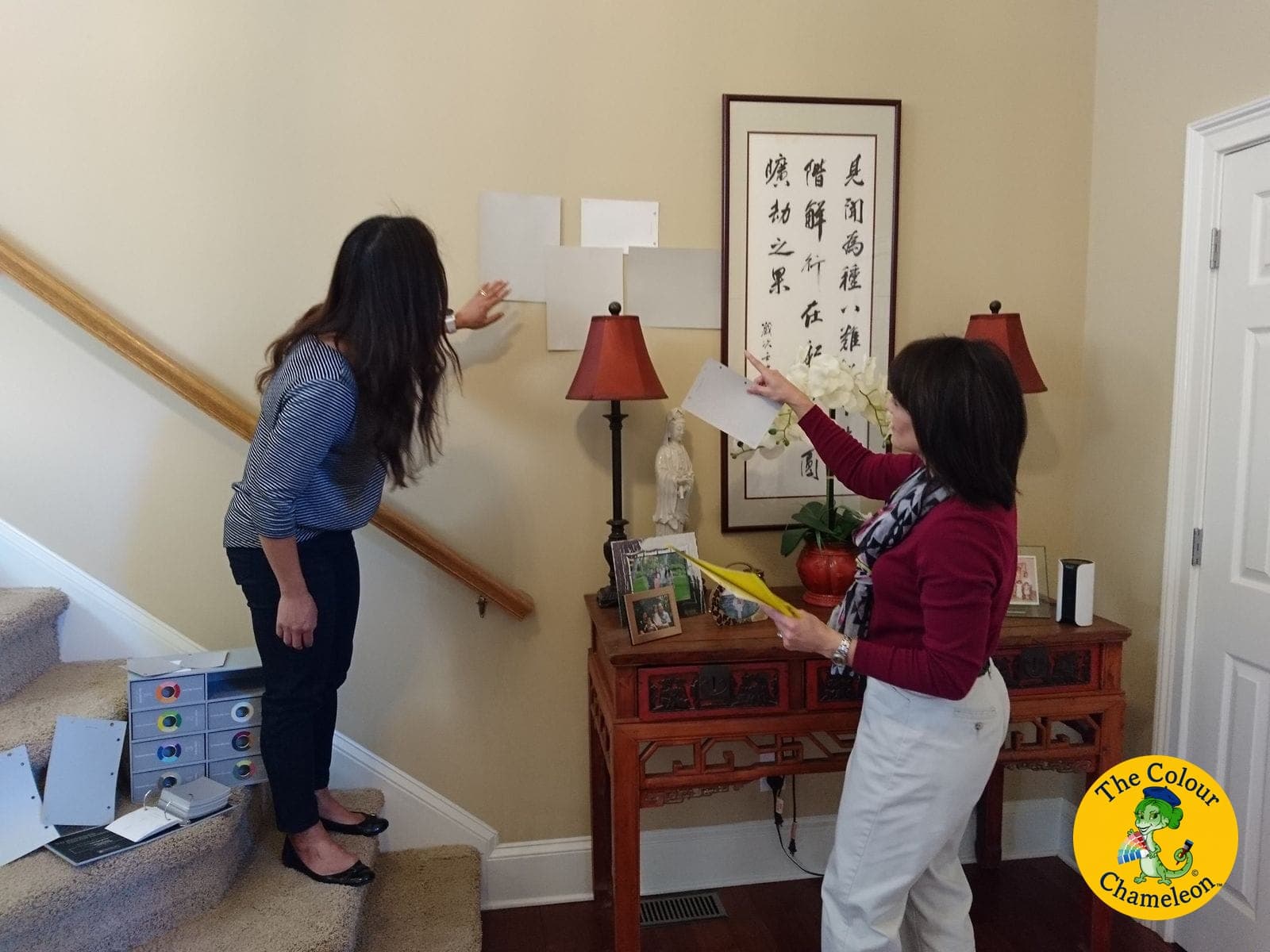
Reviewing a scheme in the stairwell it has to work in. You test it before you commit to anything
Before I go, you get the physical swatches for your new color scheme and the tips for testing them properly: where to put a sample, when in the day to look at it, and which light will lie to you. A surprising number of bad paint decisions are testing mistakes rather than taste mistakes.
Then it's yours. You test, you look, you decide — with the color already proven on your own wall, in your own light, before a single gallon of paint is bought.
- Walls
- Trim
- Ceiling
- Front door
The scheme, left on your counter.
That's the whole deliverable: a scheme built out of this house's own characteristics, and the confidence to commit to paint and labor once.
Why the color changed on the way home
Nothing was wrong with the chip. Five things in your house had already voted on it before you got there.
The light
It moves all day. A north-facing room at eight in the morning and the same room at five in the afternoon are two different rooms — and the chip only ever met the store.
The floor
Whatever is underfoot pushes its undertone up onto every wall above it. Warm oak and cool grey tile do not take the same white, and they never will.
What you're keeping
The sofa, the rug, the art you would never part with. They are already a palette, and the walls have to live alongside them rather than argue with them.
Brick, mortar and stone
Outside, the things you aren't changing decide most of it. Brick and mortar are a color scheme you already own, whether you chose it or not.
The edges
Trim and ceilings frame every color you pick. And on an exterior, the two houses either side of yours are part of the view whether you like it or not.
None of that is visible in a store. All of it is visible standing in your hallway.
The one thing I can't schedule around
A consultation runs on natural light. That isn't a preference, it's the instrument — I'm reading your rooms and your siding the way they will actually be seen, and heavy overcast takes that reading away from both of us.
So on a genuinely dark day I may ask to move us. I would rather do that than hand you a scheme I chose in bad light and let you find out about it weeks later. If your timeline is tight, say so at the start and I'll build the slack in.
It's the one thing I'll ask you to be flexible about.
Color consultant vs. interior designer
An interior designer takes on the whole room — remodeling plans, furniture, fabrics, sourcing, managing the trades — and a good one is worth every penny when that's the help you need. A color consultant takes on one decision: what color everything gets painted, in your light, against the materials you're keeping.
So the honest test is scope. If the furniture, the floors, and the layout are staying and paint is the change, a color consultation gets you a finished, tested decision in a single visit. If you're reworking the room itself, hire the designer — and I mean that.
What a consultation includesDo you need a color consultant at all?
Not always. If it's one small room, you're not torn, and the sample on the wall already agrees with you — keep going. Paint two poster boards, move them around the room for a day, and trust what you see.
Where I earn my keep is everywhere the decision is bigger than one wall: whole-home schemes that have to hand off from room to room, exteriors where the brick and the roof get a vote, cabinets, and any color that has already survived four sample pots without a winner. If that's the table you're sitting at, that's what the consultation is for.
The part people mention afterward
It's rarely the palette. It's that somebody finally listened before deciding anything.
You were my angel.
I absolutely love this woman, you have to call her.
I wish I'd known about this service before.
Two more things worth knowing
That's the whole process. Nothing behind the curtain.
Send me the rooms or the exterior, and the date your painters need an answer. I'll get back to you within 1 business day.